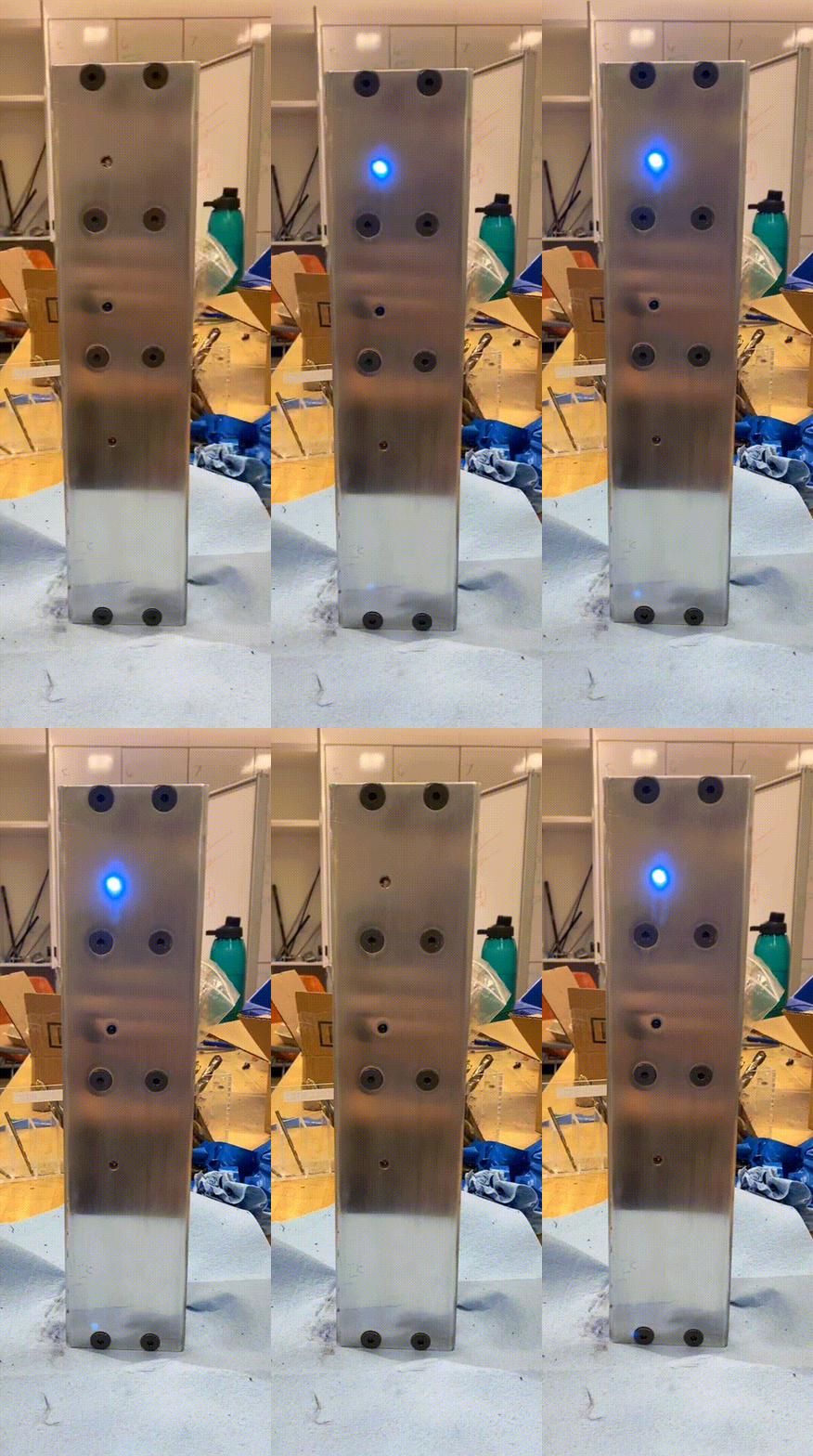
I led the payload team for Duke AERO’s entry into the 2022 Spaceport America Cup. The team competed in the 30,000 ft consumer solid motor category, with our rocket Coach 30K. The competition requires that each rocket carry a scientific experiment or technology demonstration payload and must weigh greater than 4 kg. With only these two requirements, the payload team was free to be creative and explore a wide range of possible projects.
The team settled on a muon detection experiment. Muons are created when high energy cosmic rays hit particles in the Earth’s upper atmosphere, causing them to decay into muons. Each muon has a charge of +- 1 e and is about 100 times heavier than an electron. They travel towards the surface of the Earth at 0.99c, passing through most solid objects in its path. Muons are a concern in particle physics labs as muons are detected as noise by sensitive particle detector equipment. Muons have a half life on the order of microseconds, but because of the speed at which they are traveling, relativistic effects cause observers on the ground to see them as having a much longer half life. Because of this muon flux density is proportional to altitude.
The payload team had two goals with muon detection: measure the variation of muon flux density as a function of altitude to support the theory of relativity, and to measure the muon shielding capabilities of carbon steel. In addition to external competition requirements, internal requirements from AERO’s structures team required the payload fit inside a 4.5” ID body tube and be no longer than 13 in.
Design began with considering final integration with the airframe to allow for smooth assembly on launch day. Based on layout from the structures team, the payload must mount to the forward recovery bulkhead while allowing space for a recovery eye bolt on the opposite side. Screw switches are used to power and arm the device. Through holes in the airframe allow for access to the switches once the full vehicle stack is assembled. The payload uses an isosceles triangle bolt mounting pattern to rotationally “key” the payload in the airframe. This ensures that the screw switch locations always align with the airframe through holes.
Making use of the narrow space afforded to the payload, the device stacks three muon detectors vertically with carbon steel plates in between them. During descent under parachute, the payload is oriented vertically with muon sensors facing upward. Data is collected as the rocket falls from apogee. Data may also be collected on the ascent to apogee, although muon flux density is typically low enough that few data points are collected during the short boost stage.
Carbon steel is chosen as a muon shield due to its relative availability and high density. It may be used as shielding equipment in a lab, so measuring its effectiveness would provide guidelines for developing particle detecting structures based on the amount of noise the equipment can tolerate. Additionally, given the minimum mass requirement of 4 kg and the small allocated space, steel plates help reach mass goal while serving a function.
The muon detector circuit is based on the cosmic watch project. The circuit uses a scintillator which emits light when hit with a high energy particle. A silicon photomultiplier (SiPM) detects these few photon emissions and releases a small current when hit. An arduino microcontroller reads this analog signal to record the detection of a muon.
Each muon detector is equipped with its own microcontroller to monitor the SiPM signal. A separator microcontroller reads the signal from a digital barometer to record pressure which may be post-processed to calculate altitude. The barometer sends altitude data to each detector over software serial. Each detector locally stores the time and altitude that a muon is recorded at in batches of 10. On the 10th muon, the data is written to an external drive. The batching method increases inactive detector time by reducing the number of file opening/closing operations by an order of magnitude.
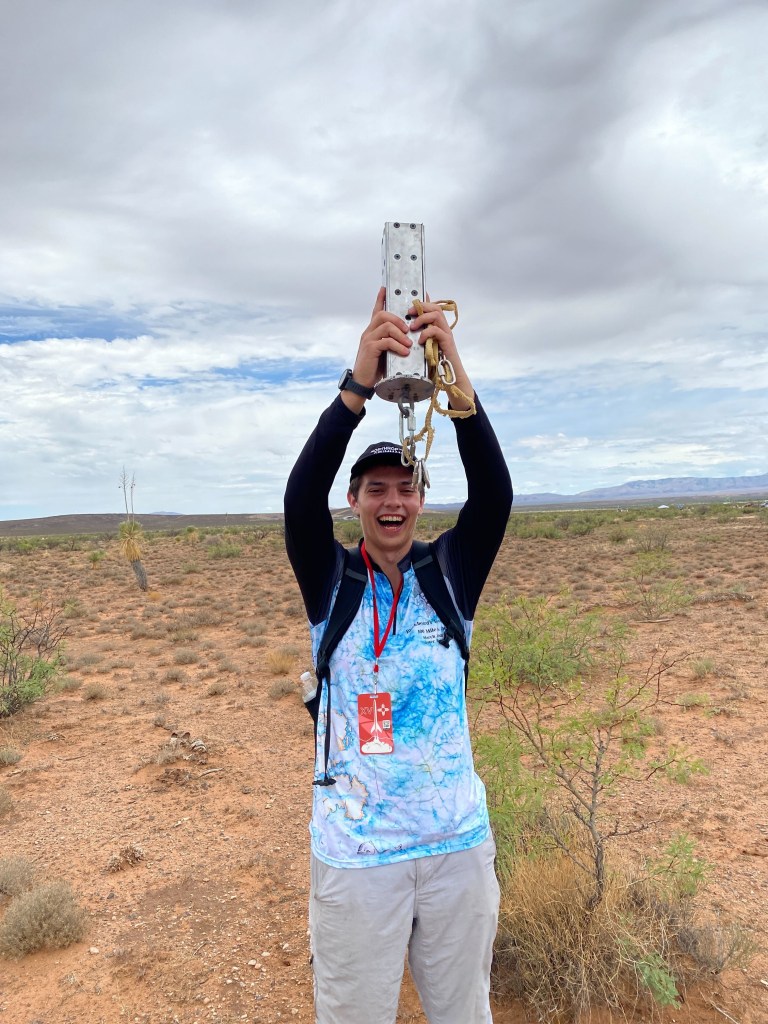
On launch day, the Coach 30K experienced an airframe failure after punching through the clouds. The payload’s solid design allowed it to survive a fall from over 20,000 ft AGL, and was the only portion of the rocket to record any telemetry. Although the muon flux density experiment could not be conducted due to the lack of falling with a parachute, the payload succeeded in collecting data during maximum acceleration and vibrational conditions.
 Chris Knotek